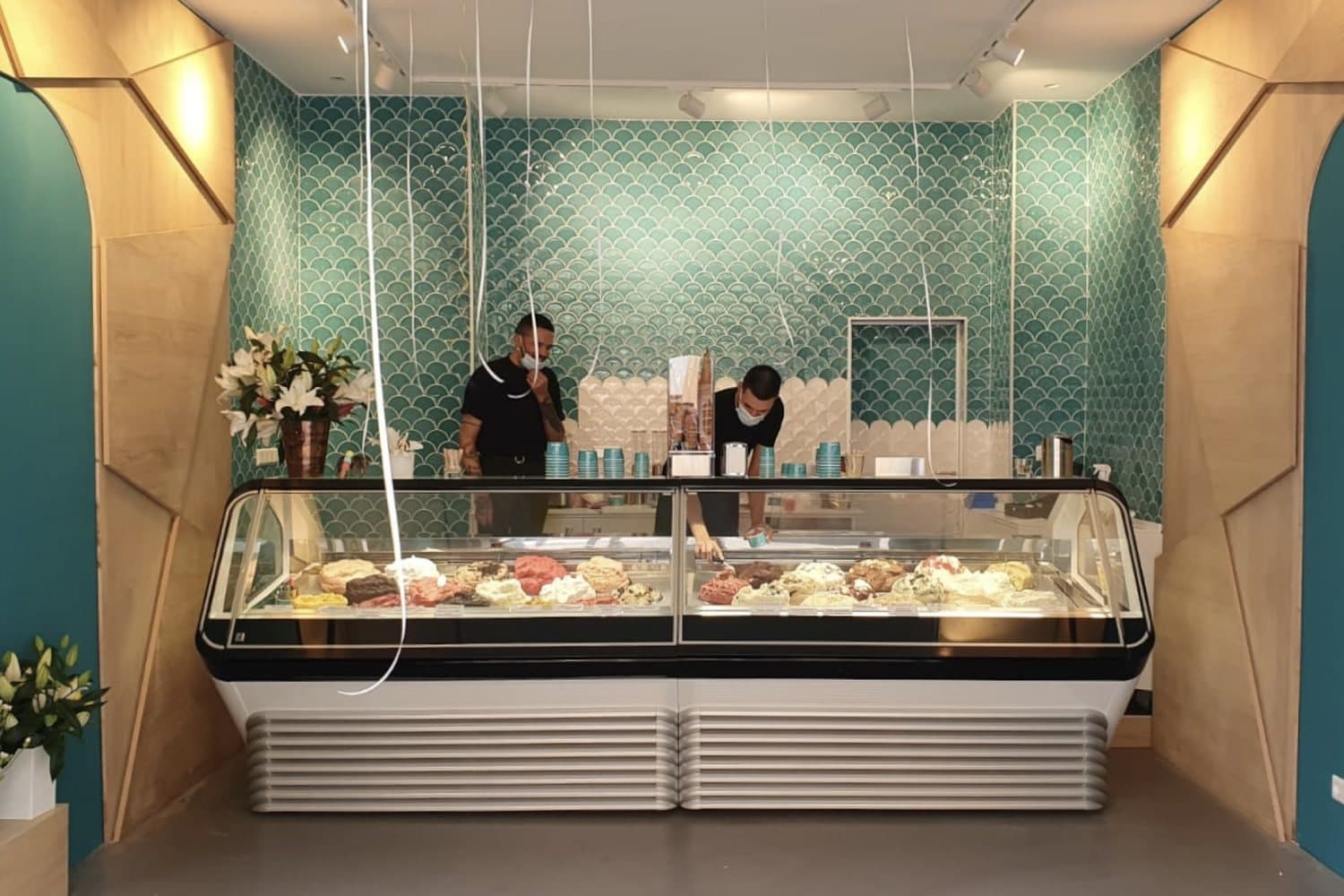
The Covid pandemic and the energy crisis have hit the restaurant trade hard, and many ice cream cafés have had to close their doors. We take a look back in time to work out what the future holds for ice cream parlours.
It's a hot summer's day, the sun's in your face and the temperature around you climbs to 30 degrees. Do you escape to a lake, the sea, the outdoor pool – or the ice cream café? We prefer the ice cream café, of course, because that's where you can cool down with a scoop of ice cream or a delicious iced coffee. But the ice cream café isn't just a place for ice-cold treats; it's also where friends meet up. Berlin's streets are hard to imagine without its many ice cream cafés, with their brightly lit lettering and all kinds of creative flavours in the counters. But should we get used to pedestrian zones without colourful ice cream parlours? Because the crises of recent years have hit ice cream cafés hard. Today we're looking at whether ice cream cafés are dying out.
First we look at their history, then at the current situation and what conditions look like for ice cream cafés after Covid. Finally, we analyse trends and look at how ice cream parlours can – and perhaps have to – adapt today so they don't die out.
What actually is an ice cream café?
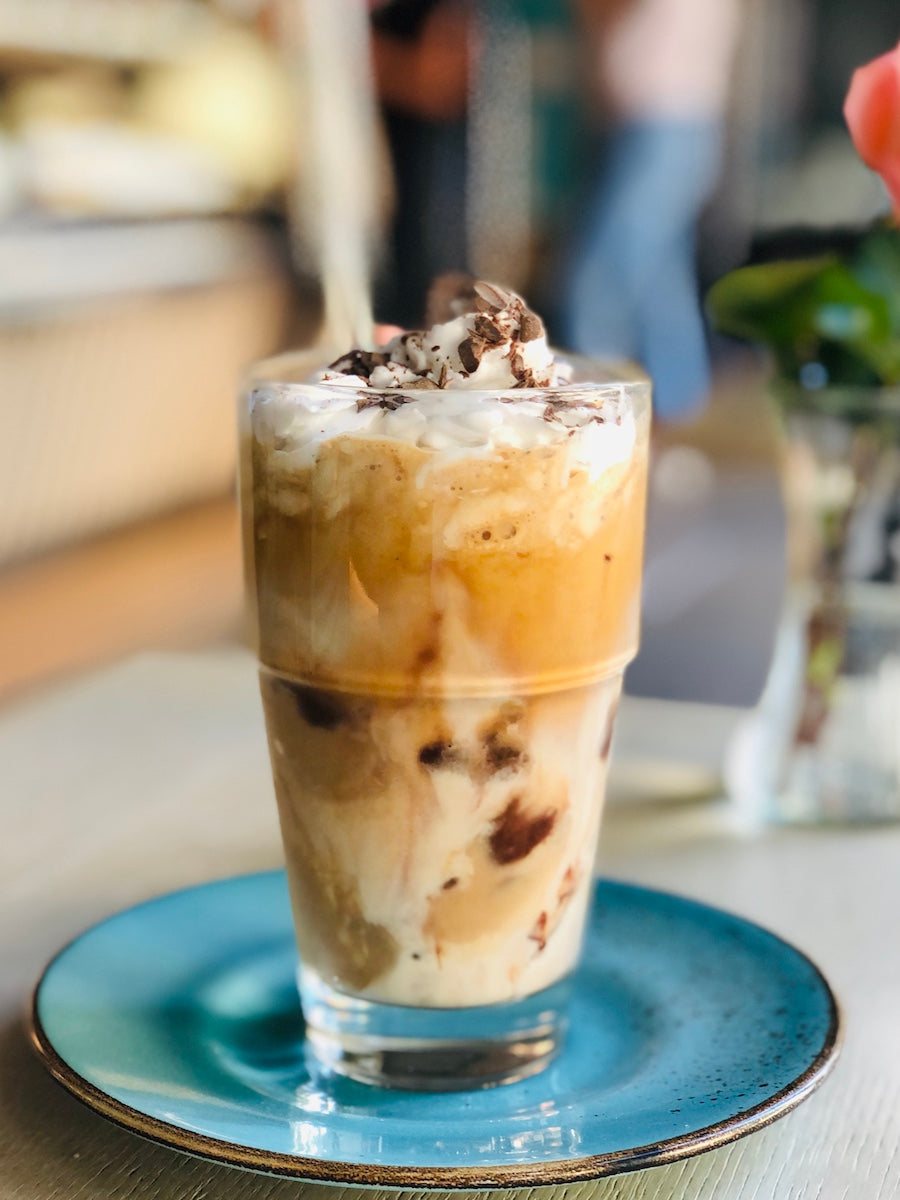
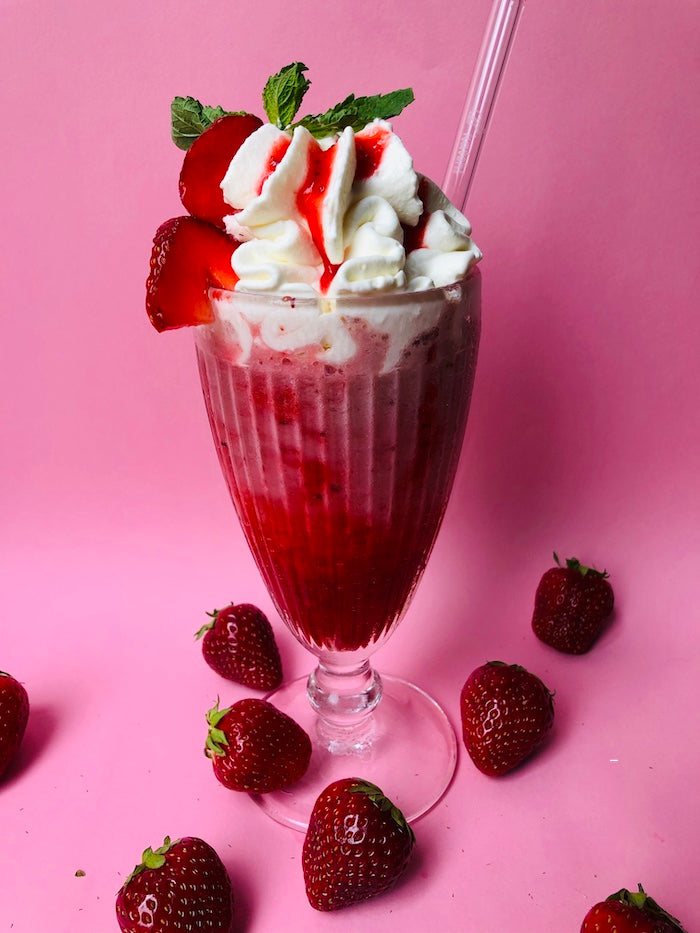
Before we get to that question, we need to clarify what an ice cream café actually is. So here's the spoiler: in German, an "Eiscafé" is the shop where you tuck into fruity or chocolatey sundaes – not "Eiskaffee", the iced coffee drink you see in the picture on the left. This article is about the café, not the drink. If you were hoping for a detailed recipe for the delicious classic, we'll have to disappoint you. For that you'll have to wait for our iced coffee article – or head to the nearest ice cream café! We won't keep a little preview from you, though: an iced coffee usually contains a scoop of ice cream – classically vanilla – one or two shots of espresso, a little espresso sauce and milk (or a milk alternative).
So now we roughly know what an ice cream café is. But we want to know more, so let's take a quick look at the history of the ice cream café in Germany. It has long been tied to Italians and Italian immigrants who brought their ice cream café culture with them. Over time it changed and adapted, but it also kept its traditions. Italian ice cream parlours, also called gelaterie, are an important part of German history today.
Why is it also called an "Eisdiele"?
Now that we've cleared up what an ice cream café is, there's just one question left: what's the difference between an "Eiscafé" and an "Eisdiele", the other German word for an ice cream parlour? So far we've used the two terms as synonyms – on purpose, because there's no clear difference. But where does the word "Eisdiele" come from? Does an ice cream parlour have something to do with boards? Because "Dielen" usually means floorboards or the hallway of a house. Neither seems to have much to do with the ice cream cafés where we indulge in sweet treats today. The explanation lies in the past. One theory says that after the war, ice cream was sold out of windows. Building on that, some argue that the windows were too high for children, so boards were laid in front of them so kids could walk up and pick a flavour. The other theory says customers had to go into the hallway of a flat, where the ice cream was sold. Neither theory has been proven – the truth probably lies somewhere in between.
In everyday language some people use the two words differently to say what kind of ice cream shop they mean. An "Eiscafé" offers a wide choice of flavours, coffee and seating, while an "Eisdiele" is a small space. By that idea, an "Eisdiele" usually has no seats and just a counter facing the street.
The history of ice cream cafés
Now let's look at the history of the ice cream café. It helps us understand how ice cream cafés have adapted again and again to changing situations – and what that can look like today. Because ice cream cafés have faced situations so tough in the past that people wondered whether they were about to die out.
From ice cream for princes and princesses to ice cream for all
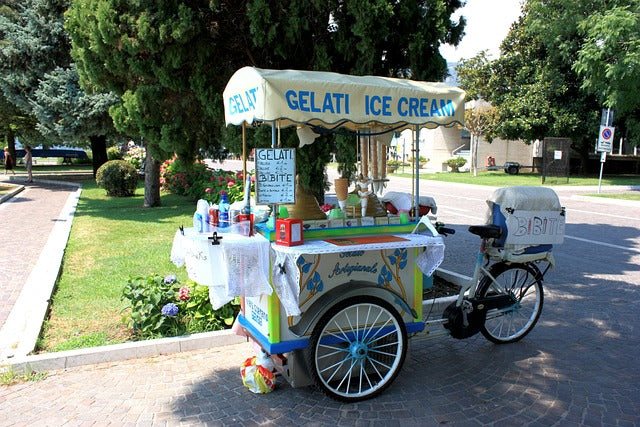
The first ice cream café in Germany probably opened in Hamburg in 1799, but it was a long road to get there. In the early modern period, when people still lived in castles, frozen desserts were a luxury that only princes, princesses and perhaps a few of their noble friends could afford. Only once the price of sugar fell did ice cream become cheaper to make, so people with less money could enjoy it too. In the 19th century, as people moved from around the castles into towns, (Italian) ice cream sellers came too, with their ice cream carts. They sold less to the nobility; instead they set up their carts in the streets and sold ice cream to the craftsmen and townspeople strolling by. That opened up ice cream to a whole new clientele. So the northern Italian ice cream makers, also known as gelatieri, didn't start out selling their ice cream in cafés, but from carts.
How Italian ice cream came to Germany
Many ice cream makers came from the northern Italian province of Belluno, where they already specialised in making sweets and ice cream. The term for Italian ice cream makers is gelatieri. The villages in Belluno were often barren and poor, so it became harder and harder to sell sweets there. To escape poverty, many gelatieri went to richer cities – often in another country. Many ice cream makers from Belluno moved to Vienna for the summer months to sell their ice cream there. In winter they went back home – what's known as temporary migration.
At the end of the 19th century, many gelatieri migrated further afield and set up their ice cream businesses there. In Vienna people quickly fell in love with ice cream and demand rose. So more and more ice cream makers came to the city, and Vienna was soon called the "ice cream capital". But not everyone welcomed them with open arms.
From ice cream cart to ice cream café
The Austrian confectioners didn't take long to react. They soon saw the Italian ice cream makers as dangerous competition and wanted to spoil their business. They pushed through a rule that from 1894 gelatieri would no longer get trade licences to sell from carts unless they had a fixed place of business. A cart wasn't a fixed place of business, so no trade licence. No licence meant no sales – and the possible end of the new business model "Italian ice cream from a cart".
But the gelatieri averted disaster by starting to rent small shops. The Italian competition hadn't gone under; it had found an innovative solution: the ice cream café. For a long time they weren't called ice cream cafés but "Gefrorenes-Salons" – frozen dessert salons. These salons spread quickly in Vienna and soon across Europe and Germany. The first ice cream cafés in Germany opened around 1880, above all in northern German cities like Hamburg. Over time the ice cream parlours conquered not just big cities but smaller industrial towns and villages, too.
Beef in the ice cream cafés: Italian ice cream cafés vs. German confectioners' cafés
Of course there was no actual beef in the Italian ice cream cafés and German confectioners' cafés – although by now there are apparently some Bavarian ice cream parlours that really do sell flavours like liver sausage ice cream. That doesn't exactly lure us to southern Germany! But back to the beef between the Italian and German cafés, because the mood between them was icy for a long time. The German confectioners feared the new competition and tried to badmouth the Italian ice cream parlours in public. Together with cinemas, ice cream carts and parlours were blamed in the 1910s and 1920s for the "moral decay" of young people. Because in both ice cream cafés and cinemas, ladies could spend time together with gentlemen – what a shock for the public! As late as 1910, one newspaper wrote that in these places the younger generation was being handed over to "the greed of pesky fruit-ice Italians".
The emphasis on fruit ice referred to the fact that Italian ice cream makers often made fruit ice or sorbets, while German confectioners focused on creamy dairy ice cream. Back then Italian ice cream was mostly not dairy-based but water-based and enriched with various fruit extracts – more of a sorbet. Sorbet was cheaper to make and could therefore be sold for less, which again annoyed the German and Austrian competition.
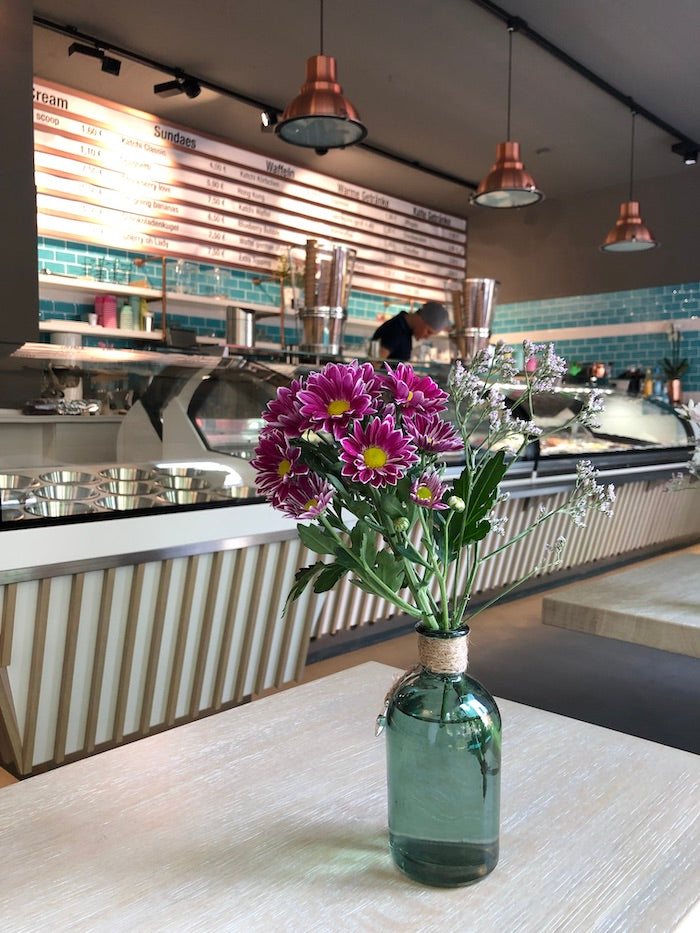
But it wasn't just what they sold that differed between the German and Italian cafés – the atmosphere and interiors were fundamentally different too. That attracted different people: Italian ice cream cafés were often full of younger people meeting up for dates, while confectioners' cafés were visited more by older people. As well as ice cream, they served cream cakes and other pastries.
Despite the many attempts to blacken the Italian ice cream cafés' name, German customers weren't put off and kept visiting them. Ice cream consumption rose steadily in the 1930s. With demand, the number of ice cream parlours grew too: there were 400 ice cream cafés in Berlin alone! This was also when the industrial ice cream industry took off, with companies like Langnese and Schöller, which still mass-produce ice cream today.
Ice cream parlours through war and dictatorship
After the Nazis seized power, the climate towards foreign business owners became increasingly hostile. Italian ice cream makers were accused of giving German confectioners too much competition. Apart from that, though, Italian businesses were largely spared Nazi restrictions, not least because of the close ties between Nazi Germany and fascist Italy. In many places Italian ice cream makers even got cheap loans to set up on their own in Germany. When the war began, however, many Italian ice cream makers returned to Italy and closed their cafés.
After the war many gelatieri came back to Germany to reopen their ice cream cafés. In the post-war years food and raw materials were strictly rationed, but ice cream parlours were favoured. They had special allocations of sugar and milk so they could keep making ice cream. Most food required ration cards, but ice cream didn't. So butter could only be bought once a week, while you could theoretically lick an ice cream every day – if you could afford it. Ice cream parlours were generously supported in other ways in the first post-war years, too. In West Germany there were few bureaucratic hurdles, which attracted more and more Italian ice cream makers. At the same time, Italian ice cream parlours were seen as a longed-for return to normality and soon as a sign of German prosperity.
In East Germany Italian ice cream was less well known. There, mainly soft serve was produced and eaten.
A visit to an ice cream café in the 50s
If you walked into the Giacomel ice cream parlour in Hamburg in 1950, you started dreaming of a sunny holiday in Italy. For many, Italy stood for something exotic and at the same time out of reach. Holidays were expensive, and after the war many people had existential worries, so a holiday seemed impossible.
Ice cream cafés tapped into this longing for a break, a holiday, an escape from grey everyday life. They decorated their parlours with pictures of Venice, Lake Garda or the Dolomites. The pictures stirred holiday feelings and promised a short stay in bella Italia far from cloudy Germany. Hit songs from the jukebox completed the ambience. No wonder young people felt at home there and met for first dates. For women in particular, the ice cream café was a popular meeting place, because unlike pubs it wasn't flooded with men and alcohol.
Angelo Giacomel's ice cream parlour welcomed you with leather bar stools, neon lights and a jukebox. The gelatiere from the northern Italian province of Belluno opened his parlour in Hamburg in 1955. The Giacomels shared the work within the family: in the cellar beneath the parlour, Angelo and his son Aurelio made the ice cream themselves; the recipes were guarded like a family secret. One floor up, mother, daughter, son, nephews and nieces served the ice cream to the guests – every day from 10 am to 10 pm between March and October.
A scoop cost ten pfennigs – unimaginable today thanks to the switch to the euro and inflation. On sunny days the Giacomels sold up to 30 litres. Hamburg's students tucked into the Giacomels' ice cream with gusto, and their shop in the university quarter flourished. The Giacomels were seasonal workers, and in autumn they went home to spend the winter in Italy. Nobody in the family wanted to stay in Germany for good. In 1989, after more than 30 years in Hamburg, they returned to Italy for good. They never found a successor, but their ice cream parlour found a place in the permanent exhibition of the Haus der Geschichte museum.
On to the 70s: in the 70s, conditions for ice cream parlours got tougher again. After the generous support of the post-war years, things turned frostier, because competition from the United States found its way to Germany. With the Americans came soft serve, together with a new ice cream café concept: the milk bar.
You might think the extra competition would have brought the Italian ice cream parlours close to extinction again. But once more the Italian parlours adapted to the new situation. They set themselves apart from the competition by emphasising their long history and tradition. They kept their family recipes alive and decorated their cafés with pictures from their founding days. That's how they grew their own markets and stood out from the competition.
The ice cream parlour today: the current situation
The ice cream parlour is still an important place to meet people and treat yourself to something sweet. But the age structure of its visitors has changed – the audience today is increasingly older. It's still a popular place for kids and teenagers, but at 39 percent, the majority of ice cream lovers (according to a Statista study) are now between 50 and 64. Will ice cream cafés have to go back to the confectioners' cafés of old to survive? Back to upholstered sofas, dim lamps and cream cakes? The clear answer: no! Because modern ice cream cafés are exactly what attracts people and where they feel at home. That goes for the older generation, too. The mix of relaxed atmosphere and ice cream goes down well – and tastes good. For many grandparents, the ice cream café is the perfect place to spend time with their grandchildren and treat them to a scoop.
From cream cake and dairy ice cream to vegan ice cream and bubble waffles
Lots of people appreciate the changed offering. Alongside all kinds of new flavours there are other new products, like the bubble waffle. Bubble waffles are made from traditional waffle batter but baked in a special iron. After the batter goes in, the iron has to be flipped to create the air bubbles typical of the bubble waffle. More and more ice cream cafés also offer bubble waffles or other freshly baked waffles, because they go so well with ice cream.
Besides the bubble waffle, other sweets are conquering the market too, like frozen yoghurt or chimney cakes. Are people eating less ice cream because of them and reaching for alternatives more often? Statistics show per-capita ice cream consumption falling by almost a litre in recent years compared with 2018. In 2021 the average person ate just under 7.9 litres of ice cream a year. That's no reason to panic and assume that soon we'll only eat frozen yoghurt and ice cream cafés will die out. Over the last 20 years ice cream consumption has kept fluctuating around 8 litres. In 2009 only 7.7 litres were eaten, while in 2018 it was 8.7 again. So we can assume this is a fluctuation that may swing back the other way – we're curious to see what the future holds.
The impact of the Covid pandemic on ice cream cafés
The Covid crisis hit the whole population hard, and ice cream cafés too: according to Statista, 248 ice cream parlours had to close between 2019 and 2020. Wow! That's more than ten times as many closures as the year before. The longer-term view also shows ice cream parlours disappearing: at the start of 2010 there were over 6,000 VAT-registered ice cream cafés, and in 2020 only just over 5,000. This constant decline sadly points towards ice cream cafés dying out. But don't panic! There are still plenty of ice cream cafés, and not every trend continues – many turn around. (The same goes for market share, for example.)
A look at the market share of industrial ice cream compared with artisan ice cream from parlours also shows losses for the parlours. In the Covid year, the share of parlour ice cream dropped by eight percent, while industry gained ground. That means ice cream cafés sold much less ice cream during Covid than in previous years, and people bought more branded ice cream in supermarkets instead. This shift is probably down to Covid closures on one hand and people's reluctance to visit restaurants or cafés on the other. But ice cream parlours are slowly recovering, and their share of ice cream sold is slowly rising again.
One way of adapting to the Covid crisis and the loss of seating was selling over the counter. Restaurants and ice cream cafés weren't allowed to offer seating to reduce the risk of infection. So they simply sold ice cream to go from the counter, wearing FFP2 masks. The friendly smile of the server was lost, sadly, but the pleasure remained. Another switch during Covid was to delivery services like Wolt or Lieferando. When restaurants and cafés had to stay closed, many had to rely on pick-up, their own delivery service or a provider like Wolt. Ordering is quick and easy – you don't have to leave the comfort of your living room and can buy what you want on your phone, delicious chocolate ice cream included.
Many people still prefer to order online rather than leave their cosy sofa. Could that mean the end of the ice cream café? We don't think so, because for many people the ice cream café isn't just the place to satisfy a craving for a fruity, creamy spaghetti ice cream, but also a place to meet a friend.
Looking back, we see that ice cream cafés began their success story as new places for meeting up and enjoying yourself. Enjoyment didn't just mean creamy ice cream, but the whole atmosphere with pictures of Venice, upholstered armchairs and hits from the jukebox. That's still true today: people don't just go to an ice cream café to buy an ice cream, but to enjoy it. The ambience is still part of it – perhaps without leather bar stools or schlager music, but with stylish wooden chairs and house music from a Bluetooth speaker. The product alone was never responsible for the success of the ice cream café and its ice cream, which is why we believe the ice cream café will remain a cherished place despite the trend towards delivery services.
The consequences of the energy crisis for ice cream cafés
The energy crisis has affected the whole population: rising costs for heating and for food. For the restaurant trade that means higher production costs, because electricity prices and raw material costs have gone up. Both are surely linked to inflation, too. In response, many ice cream cafés have raised their prices, and ice cream has become more expensive.
Some flavours cost more to make than others, nut flavours for example. Could one response to rising production costs be cutting the more expensive flavours? Yes and no – so far no such trend can be seen. On the other hand, it can't be ruled out that flavours will be cut in future. Another way to adapt would be switching to cheaper alternatives. Each ice cream café has to decide for itself whether that fits its own quality standards. At Katchi we keep using fresh, local, high-quality ingredients.
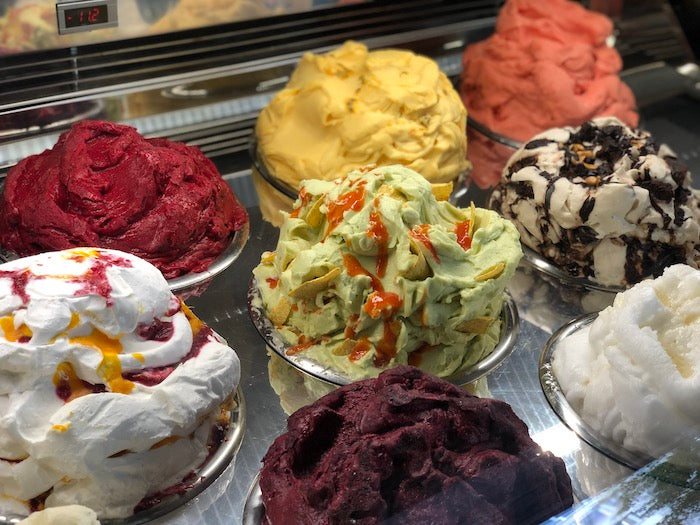
Looking at the variety of flavours in different ice cream cafés, a trend towards cutting flavours seems unlikely anyway. The trend is much more towards innovation, as Berlin Ice Cream Week shows. Every year lots of ice cream cafés take part and create a special flavour that's sold for less than the rest and only available during the week. Katchi's flavours were Matcha MiSu and Berlin Rainbow. Matcha MiSu is inspired by tiramisu, which is traditionally made with coffee and ladyfingers. Matcha is a caffeinated green tea, mostly drunk as a powder whisked with oat milk as a matcha latte. Matcha MiSu is a flavour based on a creamy dairy ice cream, layered with ladyfingers and matcha ice cream. Finding new flavours is fun and delicious – we hope this trend catches on!
Is there an ice cream café for dogs, and which ice cream can dogs eat?
Another innovative idea is to spot new needs and find an answer to them. Lots of people don't want to leave their dog behind when they go out, which means the dog comes along to the ice cream café, too. And of course it shouldn't just sit there with puppy-dog eyes watching its owner lick an ice cream. There's no dog ice cream parlour that only welcomes dogs yet. But some ice cream parlours offer flavours that are suitable for dogs or made especially for them.
On Lake Garda in Italy, for example, there's the dog ice cream parlour mydog. If you're at an ice cream parlour that doesn't offer special dog ice cream, your dog doesn't have to sit there sulking. Dogs can have small portions of "normal" ice cream. Just make sure it doesn't contain any ingredients that are harmful to dogs, such as chocolate, xylitol, artificial sweeteners, grapes, raisins, avocado, macadamia nuts or almonds.
Where is the biggest ice cream parlour in the world?
The biggest ice cream parlour in the world is currently in Havana, Cuba. Among vintage cars and ornate houses you'll find the Coppelia ice cream parlour. On 16,000 m², it sells ice cream throughout the day to what amounts to half a football stadium. Almost 20,000 customers a day visit the café with its 600 seats and two-storey pavilion. When you enter, signposts help you find your way around the huge site and find a seat. Even though the parlour has so many seats, people queue an hour before opening, and long queues form at the five entrances throughout the day. That's why there are even bouncers.
It can hardly be down to the huge choice, though, because there are usually only two or three flavours, sometimes six – depending on what the producers have in stock. That's because of the trade embargoes socialist Cuba is subject to, which make production difficult due to a lack of raw materials. The most popular order, the "salad" with five mixed scoops, can quickly turn into an unmixed salad with five scoops of vanilla. The temperatures let you eat a lot of ice cream. Then people don't order one salad but two, and there are 50 scoops for five people. People love the ice cream for its delicious taste, but also for its great price. A scoop costs the equivalent of seven cents, a bargain even by Cuban standards. That's possible because the parlour is state-owned. It was built in 1966 on Fidel Castro's orders, because he loved ice cream and wanted everyone to be able to afford one.
Ice cream cafés on the road to sustainability
In Germany we can only dream of prices like that. Here, ice cream cafés have to find answers to inflation and the energy crisis and adapt to new demands, too. Such as the need for sustainable consumption and places that make it possible. We're becoming more and more aware of our responsibility for the planet and how our way of consuming and doing business drives climate change. So the wish to live more sustainably is reaching more and more people.
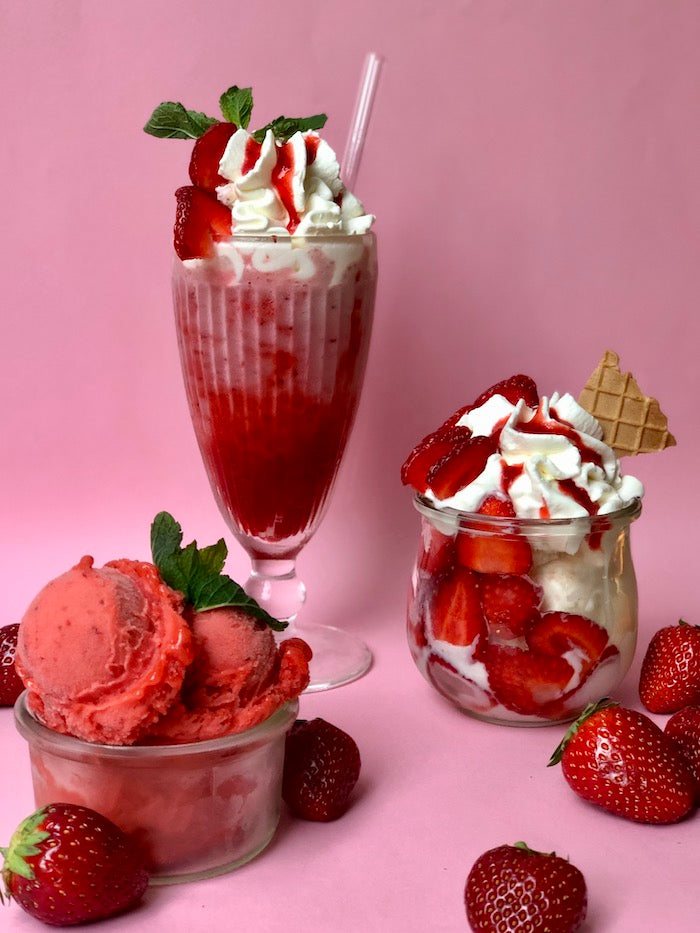
Ice cream cafés can respond by offering vegan flavours and vegan alternatives for drinks, because a vegan lifestyle is much more environmentally friendly than an omnivorous or even vegetarian one. Many classic sundaes, like the popular spaghetti ice cream, already come in vegan versions: in the picture on the left with mango sorbet, chocolate sauce and coconut sprinkles. Another sought-after step towards sustainability is offering reusable cups. There are government requirements here too, such as the obligation to offer reusable containers for takeaway. Companies like Recup offer a nationwide deposit cup system that makes switching easier.
Sustainability isn't just about the environment, though – it has a social side, too. That fits with the fact that sales of Fairtrade ice cream have shot up in recent years. In 2019 just under 7.9 million litres of Fairtrade ice cream were sold; in 2021 it was already 10.4 million. Ice cream cafés should be aware of this trend so they can adapt to new consumer needs. Then they won't die out – and, in the best case, neither will we ;)
Conclusion: ice cream cafés are not dying out
Are ice cream cafés dying out? We think that's rather unlikely. Ever since ice cream parlours appeared, they've faced situations that threatened their existence again and again. Like when there was beef with the confectioners, which cost them their licences to sell ice cream from carts. Or when the American competition arrived in Germany with soft serve. In both cases, ice cream café owners found creative solutions – switching from cart to café and going back to tradition.
Today conditions for ice cream cafés have got tougher again, because the Covid and energy crises have taken a heavy toll. But history shows how adaptable they are, and we're counting on that today, too. Industrial branded ice cream from the corner shop is no substitute for a freshly scooped ball from an ice cream parlour – not in taste, not in creaminess, and certainly not in atmosphere.
Ice cream cafés have an important place in our society and culture, because they're places for getting together. Almost everyone probably has memories of visiting an ice cream parlour, whether as a child with their parents, on a first date or meeting friends. For some it was even their first job – then perhaps it wasn't only a place of cosiness ;) In ice cream cafés there's music, you sit on nice furniture and enjoy not just a spaghetti ice cream but the whole atmosphere. We firmly believe that will stay possible.